
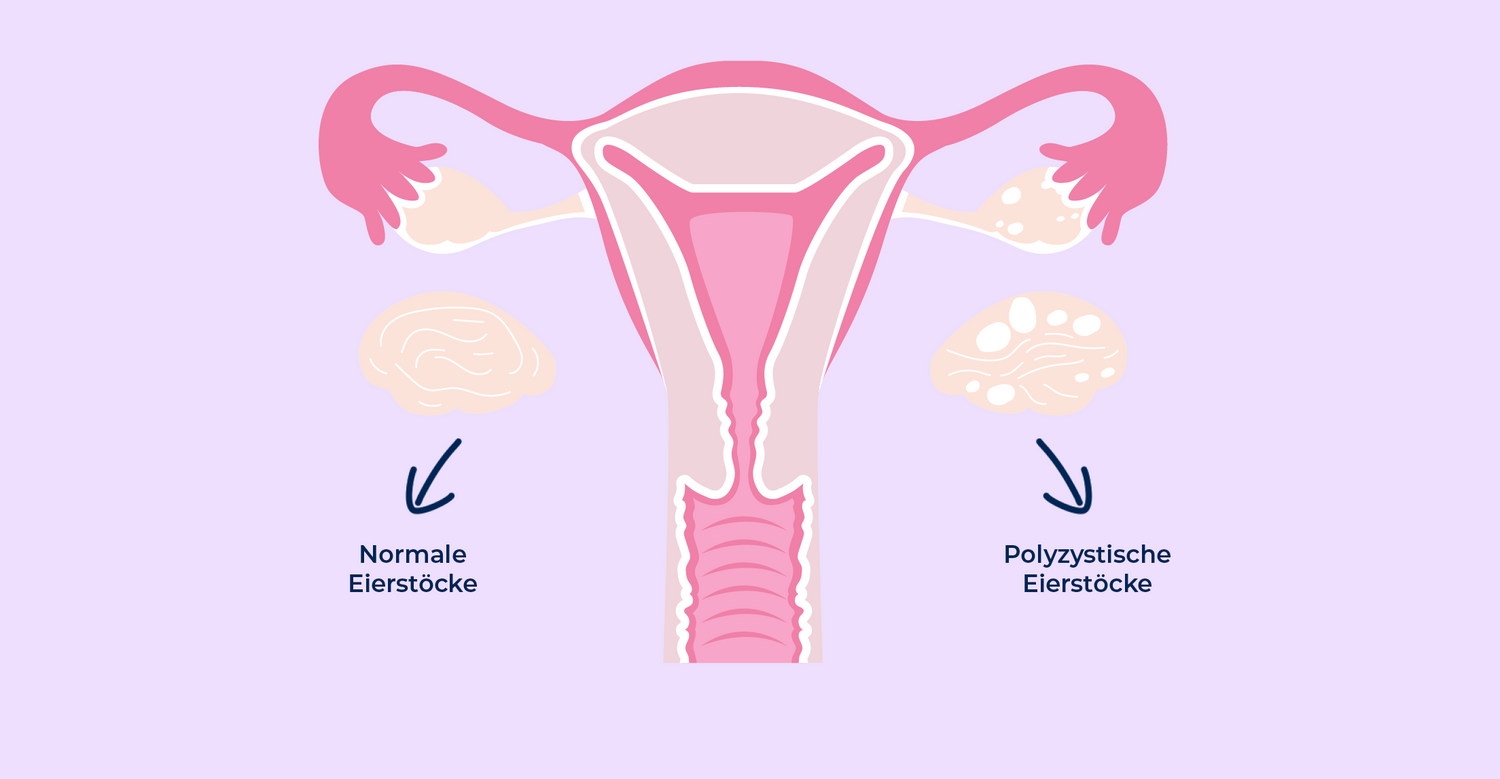
Key Takeaways
- As many as 5 to 10 percent of all people of childbearing age with ovaries suffer from the hormonal disorder PCOS.
- The result is a malfunction of the ovaries, on which cysts form.
- In this article you will learn everything about causes, diagnosis and treatment options.
It is one of the most common causes of infertility, yet many people know little about it: Polycystic Ovary Syndrome (PCOS) affects around 5 to 10 percent of people with ovaries of reproductive age. In this article, we explain what PCOS actually is, what the typical symptoms are, and what treatment options are available.
What is PCOS?
PCOS is a disorder of the hormonal regulatory system—the exact cause is unknown. It is suspected, however, that the effect of the follicle-stimulating hormone (FSH) is blocked due to structural changes.
Who is affected by PCOS?
PCOS usually first appears between the ages of 15 and 25. It is estimated that about one million people with ovaries in Germany are affected by the condition.
What happens in the body with PCOS?
The concentration of luteinizing hormone (LH)...
Read more in the Ovy Premium App
 Access to all articles and all Ovy App functions


Medically Reviewed
This text was created by medical editors on the basis of specialist medical literature and current studies. Our aim is to work scientifically, identify sources and regularly check that the content is up to date.
References & Literature
- PCOS Self-Help: Information for Patients. 2013 [cited 21.07.2021]. Available at: https://www.pcos-selbsthilfe.org/media/2014/PCOS-Patientinnen-Broschuere-2014.pdf
- Stuttgart Hospital: PCOS: Polycystic Ovary Syndrome. n.d. [cited 21.07.2021]. Available at: https://www.klinikum-stuttgart.de/kliniken-institute-zentren/frauenklinik-schwerpunkt-gynaekologie/klinische-schwerpunkte/endokrinologie/pcos-syndrom-der-polyzystischen-ovarien
- German Menopause Society: Polycystic Ovary Syndrome (PCOS) and Menopause – What should I know? 2020 [cited 21.07.2021]. Available at: https://www.menopause-gesellschaft.de/themen/das-polyzystische-ovarsyndrom-pcos-und-menopause/
- Department of Gynecology and Obstetrics: Polycystic Ovary Syndrome (PCOS). n.d. [cited 21.07.2021]. Available at: https://www.ukm.de/index.php?id=3549
- Álvarez-Blasco F, Botella-Carretero JI, San Millán JL, Escobar-Morreale HF. Prevalence and Characteristics of the Polycystic Ovary Syndrome in Overweight and Obese Women. Arch Intern Med. 2006;166(19):2081–2086. https://doi.org/10.1001/archinte.166.19.2081
- Norman, RJ, Dewailly, D., Legro, RS & Hickey, TE Polycystic ovary syndrome. Lancet. 2007;370:685–697.
- Tata B, Mimouni N, Barbotin A, et al. Elevated prenatal anti-Müllerian hormone reprograms the fetus and induces polycystic ovary syndrome in adulthood. Nat Med. 2018; 24:834–846. https://doi.org/10.1038/s41591-018-0035-5
- Mannerås-Holm L, Baghaei F, Holm G, Janson PO, Ohlsson C, Lönn M, Stener-Victorin E. Coagulation and fibrinolytic disturbances in women with polycystic ovary syndrome. The Journal of Clinical Endocrinology & Metabolism. 2011;96,(4):1068–1076. https://doi.org/10.1210/jc.2010-2279
- Teede et al., International PCOS Network. et al. Recommendations from the international evidence-based guideline for the assessment and management of polycystic ovary syndrome. Hum. 2018;33(9):1602-1618. https://doi.org/10.1111/cen.13795
- Khan, Muhammad Jaseem, Anwar Ullah, and Sulman Basit. "Genetic basis of polycystic ovary syndrome (PCOS): current perspectives." The application of clinical genetics 12 (2019): 249.
- Hoeger, Kathleen M., Anuja Dokras, and Terhi Piltonen. "Update on PCOS: consequences, challenges, and guiding treatment." The Journal of Clinical Endocrinology & Metabolism 106.3 (2021): e1071-e1083.
- Ajmal, Nida, Sanam Zeib Khan, and Rozeena Shaikh. "Polycystic ovary syndrome (PCOS) and genetic predisposition: A review article." European journal of obstetrics & gynecology and reproductive biology: X 3 (2019): 100060.
