
Key Takeaways
- Using ovulation tests regularly can be useful when trying to become pregnant or avoid becoming pregnant.
- Ovulation tests measure the concentration of luteinizing hormone and can thus determine the time of ovulation.
- In this article you will learn everything about how to use and evaluate ovulation tests.
Ovulation tests help identify the most fertile days in your cycle and the day of ovulation. They detect the concentration of luteinizing hormone (LH) in urine, which provides information about ovulation and fertility. This article explains how ovulation tests work.
How does an ovulation test work?
To understand how an ovulation test works, it is first necessary to understand the hormonal processes in the cycle that are relevant for the test .
During the menstrual cycle, the concentration of various regulatory hormones rises and falls, thus ensuring the build-up of the uterine lining, stimulating follicle growth, and ultimately triggering ovulation. LH is responsible for this process.
FSH in the ovaries stimulates the growth of follicles. These produce estrogens, which, above a certain level, cause the pituitary gland to release LH. When the luteinizing hormone reaches its highest concentration, the so-called LH surge, it takes approximately nine to 24 hours for ovulation to be triggered.
It travels to the follicles (egg sacs), whereupon the largest of the mature follicles ruptures and releases the egg. On its way to the uterus, the egg can be fertilized. The ruptured follicle develops into the corpus luteum, which releases the hormone progesterone. This inhibits the release of FSH and LH. If pregnancy does not occur, the concentrations of progesterone and estrogen drop sharply, triggering menstruation. Simultaneously, this drop in levels means that the release of FSH and LH is no longer inhibited, and FSH can once again stimulate the growth of follicles in the ovaries.
Ovulation tests can determine on which days the LH concentration is particularly high. In the first phase of the cycle, the normal value is between 1.9 and 12.5 IU/L. At the time of ovulation, the concentration is between 8.7 and 76.3 IU/L. The test reacts at an LH level as low as 25 mIU/ml.
Important: Ovulation tests only show a positive result shortly before ovulation (24 to 36 hours), so if you want to conceive, you should take advantage of your fertile window as soon as possible after a positive result. You are most fertile on the day of the LH surge and the day after.
When is the right time to use ovulation tests?
To avoid wasting test strips, it's important to start using them at the right time. A cycle begins on the first day of menstruation and ends with the start of the next period. A normal cycle length is between 21 and 35 days. It's helpful to already know your cycle fairly well if you 're using ovulation tests for the first time.
The testing phase should begin around day eight to ten of your cycle if it's less than 30 days long. If your cycle is longer than 30 days, you can start five days before your first higher temperature reading (marked with the abbreviation ehM in the cycle chart in the Ovy app). You can also pay attention to changes in your cervical mucus. In the days leading up to ovulation, it will become increasingly clear and stretchy, indicating that you can begin using ovulation tests.
When using the Ovy app, you start using the test strips on the first day of the phase marked green in the app's "Getting Pregnant" mode and orange in its "Tracking Cycle" mode. To avoid missing the LH surge, the test should ideally be performed daily during the green/orange phase until ovulation is confirmed.
How is an ovulation test used?
The principle and application of an ovulation test are similar to those of a pregnancy test. It's best to follow this checklist:
- Use the Ovy app to determine your fertile days in your cycle and thus the right time to take the test.
- To obtain comparable results, ovulation tests should always be performed at approximately the same time, ideally between 10 a.m. and 8 p.m.
- Do not use the test on your first morning urine, as the LH concentration is higher in it and the test result could therefore be a "false positive".
- Avoid drinking anything for about two to three hours before the test so that the concentration of hormones in the urine is not diluted and the test is not distorted.
The test procedure: Here's how it works:
- Collect a urine sample using a clean, dry container. Alternatively, you can perform the test directly in the urine stream.
- Immerse the test strip vertically into the urine sample for at least 10 seconds with the arrows pointing downwards. Caution: Only touch the test on the colored side.
- Place the test strip on a clean, dry, and non-absorbent surface. After ten minutes, you can read the test result.
How is the Ovy ovulation test evaluated?
After approximately ten minutes, the result will be clearly visible on the test strip. To determine your result, you must compare the color intensity of the test line (T) with the color of the control line (C). The appearance of a colored line in the control area (C) indicates that you have used the test correctly and the correct amount of urine has been absorbed.

Here's how to add your result to the Ovy app:
- Select “Add body signals”.
- Click on “Ovulation test” and “Add test”.
- You can now take a photo of your test strip or select the test result without a photo.
- You can view all recorded test results via “View test results”.
- You can delete incorrectly entered tests by going to the overview page of the test results (under “View test results”) and swiping the incorrectly entered ovulation test to the left.

Positive result:
Two colored lines are visible, and the test line (T) is the same color as or darker than the control line (C). A positive result does not change after the test is completed after ten minutes. A positive result appears approximately 24 to 36 hours before ovulation. This is the most fertile time in your cycle and the ideal time for intercourse if you want to get pregnant.
In "Getting Pregnant" mode, the first positive ovulation test of the cycle is factored into the analysis. A recorded positive ovulation test means that ovulation is expected within the next 24-36 hours, and the Ovy app will display this as ovulation two days later. Further positive ovulation tests have no effect on the calculated ovulation date.
Negative result:
A control line (C) is visible, or the test line (T) is lighter than the control line. To confirm a negative result, the full reaction time of ten minutes is required. If you get a negative test, no LH surge was detected. You should test again the following day. Continue testing within the six fertile days of your cycle until you get a positive result.
In the “Getting pregnant” mode, negative ovulation tests are not included in the evaluation.
Invalid result:
If no line or only one test line (T) appears after ten minutes, the result is invalid and the test should be repeated with a new test strip.
In what unit is the LH value measured?
The Ovy ovulation test reacts even at an LH level as low as 25 mIU/ml. IU is an internationally standardized unit of measurement and stands for International Units. mIU/ml means milli-IU per milliliter. Remember: The more sensitive an ovulation test is, the lower the mIU/ml value at which it detects a positive result.
What if I don't get a positive test result?
If all the test strips in the pack are used up and there is still no positive result, this could be due to a later or earlier ovulation, or a lack of ovulation. In this case, a new pack can be started, or the tests can be started again in the next cycle, even before the start of the fertile window. If no LH surge can be detected despite daily testing in three consecutive cycles, we recommend consulting your gynecologist.
Are ovulation tests sufficient to determine fertile days?
In addition to using ovulation tests , it is recommended to measure your basal body temperature daily using the Ovy Bluetooth basal thermometer and to observe your cervical mucus . The latter changes its consistency several days before ovulation due to the rise in estrogen, which is why analyzing cervical mucus provides additional certainty in determining your fertile days. Both bodily signals, basal body temperature and cervical mucus, are incorporated into the Ovy app's calculation of fertile days.
Can I use an ovulation test for contraception?
Ovulation tests are not a contraceptive. Their use is recommended for couples trying to conceive.
Where can I buy an ovulation test?
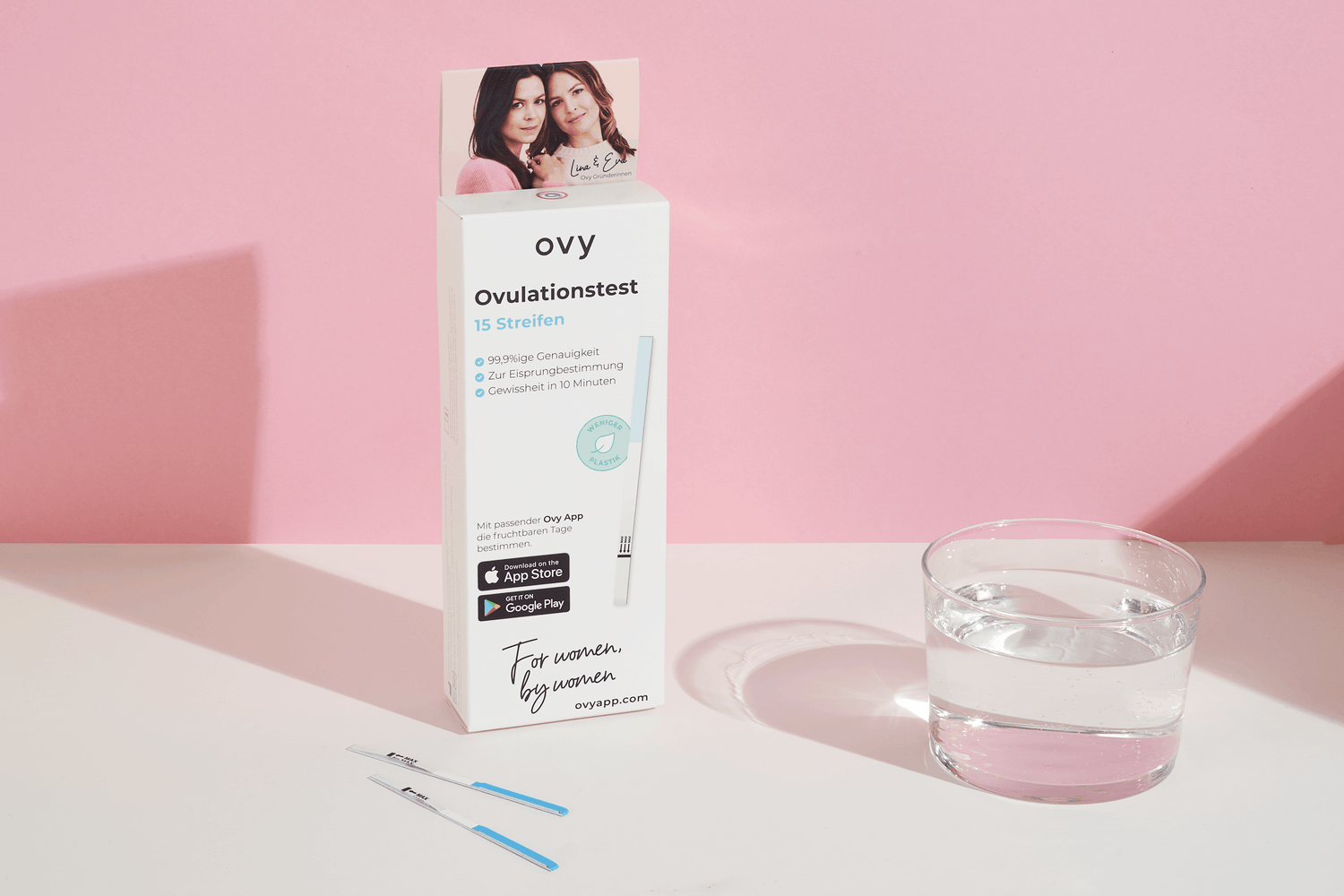
Ovulation tests are available over the counter without a prescription. The Ovy ovulation test is available in our online shop. Each pack contains 15 individual test strips.
Medically Reviewed
This text was created by medical editors on the basis of specialist medical literature and current studies. Our aim is to work scientifically, identify sources and regularly check that the content is up to date.
References & Literature
- Paul MD, Miller B, Michael MD, Soules R (1996) The usefulness of a urinary LH kit for ovulation prediction during menstrual cycles of normal women. Obstetrics Gynecology. Volume 87, Issue 1
- Neena B. Schwartz. (1974). The Role of FSH and LH and of Their Antibodies on Follicle Growth and on Ovulation. Biology of Reproduction, Volume 10, Issue 2, 1 March 1974, Pages 236–272
- Wallwiener, LM., Toth, B. (2014). Follicular maturation disorder and corpus luteum insufficiency. In: Gnoth, C., Mallmann, P. (eds) Periconceptional Gynecology. Springer, Berlin, Heidelberg.
